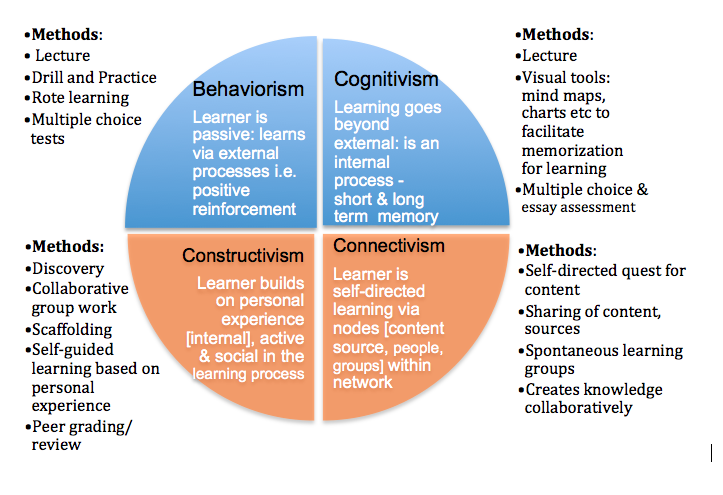
Last week Trevor MacKenzie gave an informative and very illuminating presentation positing the need for a constructivist approach to learning which argues for student agency and control of learning in the classroom. He emphasized the need for students to be both cognitively and physically active in the learning space. In the Q & A portion of his presentation, he demonstrated constructivism in action by explaining how he co-constructs rubrics and core competencies with students. I found this fascinating because I had viewed things like competencies and rubrics to be areas of concern for the teachers only. Now that I know that when students fully understand what is being assessed and the gap between the teacher’s expectations (be it curriculum or assessment) and students understanding is bridged, it makes sense that student performance will improve and I will definitely try to implement this in my classroom.
I am still a little confused about his explanation of transitioning away from novel studies units to a unit centered around concepts. I understand that this is an attempt to include different underrepresented voices and identities into the canon, but I hope that it would not exclude amazing literature simple for the crime of being old.
MacKenzie also rightly claimed that our learner narrative shapes how we as teachers teach but that not all students learn exactly like the teacher. I never really had considered how the way I learned in the past would influence my teaching practice and how it will inevitably manifests itself in the way I delivered course content and assessment. The thing that I took away from his presentation is how impactful our words and dialogue with students have on a student’s identity and future learning experiences. In the future, I hope that I will remain conscious of that when I speak with students and understand the consequences of these interactions. The unscripted interaction with a former professor of Trevor’s underscored that point. What to the professor was probably a innocuous moment of consideration was interpreted as a profound act of compassion and generosity to the student that positively affected his learning journey.
Leave a Reply
You must be logged in to post a comment.