I used Canva to make a review sheet of the various ways to say “only” in Korean.
Category: Free Inquiry (Page 1 of 2)
This is the category to apply to your Free Inquiry posts.
I have used ‘Screencast-O-Matic’ to record myself translating a Korean text about Kimchi in real time. I was getting rusty in my translation ability, but pleasantly surprised how quickly it comes back with practice. Basically, as Korean is a S-O-V language, you need to read the sentence backwards in your head and then translate back into English familiar S-V-O syntax.
These are some tricky advanced multi-meaning verbs I am studying right now. I used a Google docs and converted it into a PDF. All photos courtesy of Unsplash
Using Screencast-o-matic software, I read a Korean advanced dialogue in Korean and then give the English translation and identify and explain the Korean idioms that which contain the word rice cake. Rice cakes, signifying good fortune and giving, are ubiquitous in Korean culture, forming a huge part of Korean food culture and gift giving. Therefore, over time many culturally specific idioms relating to rice cakes are present in the Korean language.
Unlike onomatopoeias, which attempt to mimic a particular sound, mimetic verbs attempt to add feeling to a motion or movement to give the listener a more detailed picture of an action. Mimetic verbs are arguably the final hurdle in achieving fluency and sounding “Korean” as they are routinely used by native Korean speakers. These are difficult for Korean second language learners to learn as there are few resources for formal instruction on this topic. Moreover, there is a astonishingly a specific mimetic word for almost every kind of movement until recently, there was little standardization of spelling and slight variations in sound are still very common.
Let’s look at some examples:
오늘 아침에 일어나서 교육에 응용기술 수업에 다니기에 대학교에 운전 해 갔어요.
I got up early this morning and drove to my applied technology in education class.
오늘 아침에 벌떡 일어나서 교육에 응용기술 수업에 다니기에 대학교에 운전 해 갔어요.
I sprung out of bed early this morning and drove to my applied technology in education class.
쓰레기가 많아서 방을 청소할 수밖에 없어요.
I had to clean the room because it was so dirty.
쓰레기가 많아서 싹 방을 청소할 수밖에 없어요.
I had to completely clean (from top to bottom) the room because it was so dirty.
As you can see above, the addition of a mimetic verb adds an emphasis of degree feeling, imagery which really lets the listener visualize the action.
Here are 14 Mimetic Verbs I will try to learn to use this week:
- 칭칭 8. 졸졸
- 가득 9. 뻘뻘
- 깜짝 10. 꼭꼭
- 엉엉 11. 철철
- 낄낄 12. 벅벅
- 콕콕 13. 펑펑
- 꽁꽁 14. 텅텅
- a. crying profusely
- b. water coming out slowly
- c. sweating a lot
- d. exerting effort repeatedly
- e. somebody scratching f. going around something
- g. water, blood, energy flowing
- h. somebody snickering
- i. stinging pain j. using an object frivolously
- k. something being frozen l. being completely empty
- m. something wrapping around
- n. completely full / stuffed


This is a little off topic from learning Korean but I just wanted to share a project I’m working on for my multiliteracies class. This is the title page from a graphic novel I’m working on using Comic 3 software.
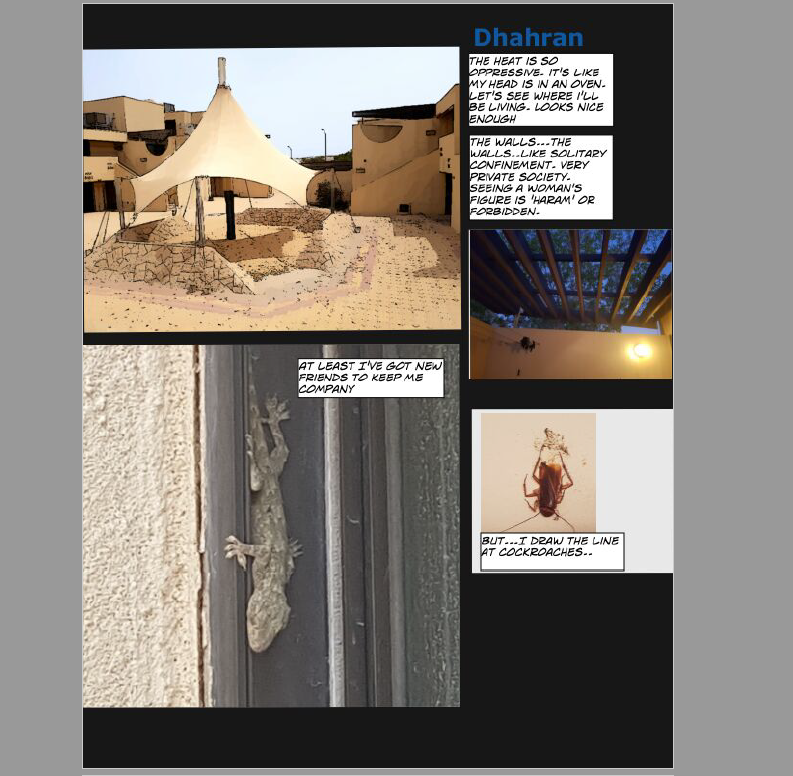
Definitely not Stan Lee but I see a lot of potential in this program for getting students to demonstrate understanding of periods in history in a visually appealing way.
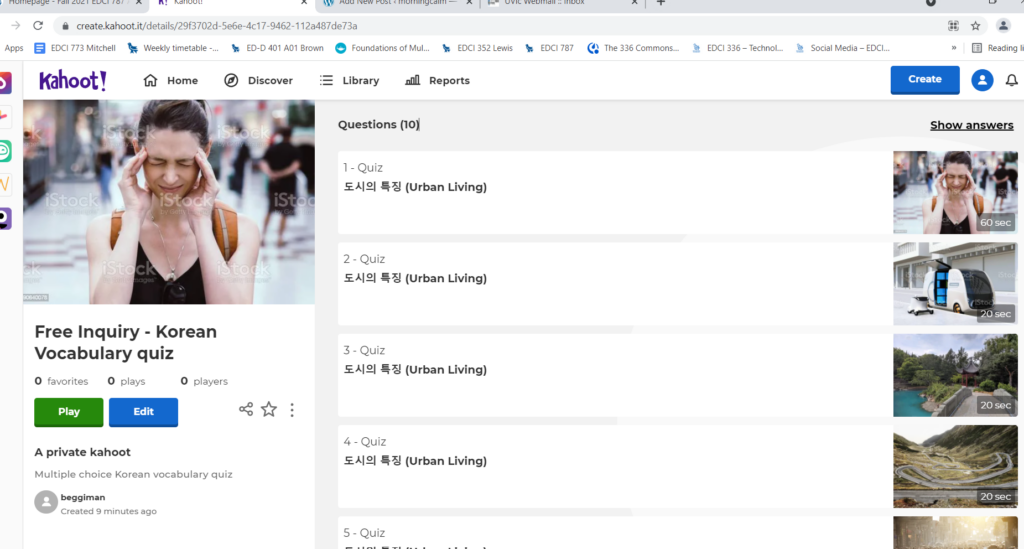
Here is a small 10 question Korean Vocabulary Quiz I made on Kahoot! to review vocabulary related to the theme Urban Living which I had been reviewing.
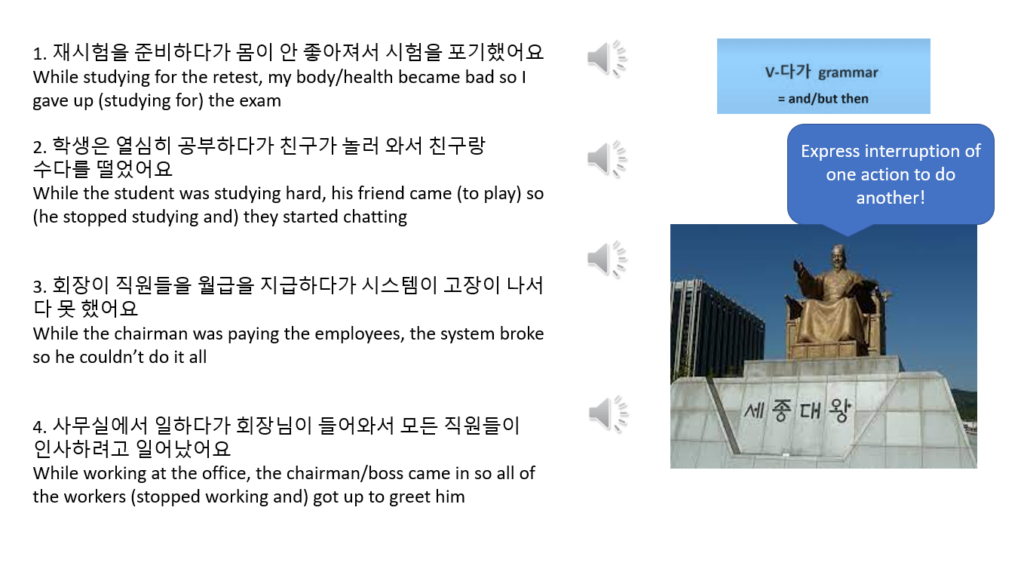
Today, I practiced combining new grammar and taping my voice speaking sentences in Korean. After speaking the sentence, I pasted the audio files to the PowerPoint
Grammar Lesson 2: – 고 보니 Expressing Discovery and Result
가: 둘이 아는 사이였어요?
Do you two know each other?
나: 네, 처음에 누군지 몰랐는데 만나고 보니 옛직업 동뇨였어요.
Yeah, At first, I didn’t know who it was, but after meeting him, I realized that we used to work together.
가: 브라이언 씨, 오늘 왜 도시락 안 가지고 갔어요?
Brian, why didn’t you take your lunch today?
나: 미안, 아침에 안 가지고 나갔어요. 학교에 도착하고 보니 도시락이 없더라고요.
Sorry, I left without it. I realized it when I arrived at school.
Meaning in Use
- This expression is used to indicate that the speaker learned something new, or discovered some new information, or discovered something contrary to previously thought after some action occurred.
비슷하게 생겨서 제 신발인 줄 알고 신었어요. 그런데 신고 보니 동생의 신발이었어요.
자동차 우화전으로 돌아서 가고 보니 잘못 방향으로 가는것이었요.
This grammar can only be used with verbs. If an adjective or noun / 이다 precedes this grammar, it is grammatically incorrect.
To use adjectives, you must change it to 아/어지다. For example,
전에 축구에 폐력이 좋았는데 나이가 많고 보니 젊은 선수와 축구를 하면 숨 차게 돼네요.
전에 축구에 폐력이 좋았는데 나이가 많아지고 보니 젊은 선수와 축구를 하면 숨 차게 돼네요.
I didn’t notice when I was young, but after having been an expat for so long, I realized how tiring it is.
어렸을때 몰랐는데 오래간 객지생활이고 보니 객지생활 얼마나 힘들다는 것을 새삼 알게 되었어요.
어렸을때 몰랐는데 오래간 객지생활 되고 보니 객지생활 얼마나 힘들다는 것을 새삼 알게 되었어요.
In this stage of my free inquiry, I have decided to translate a long text on Korean public-school education, focusing on vocabulary related to education. I have finished the first paragraph, and I will complete the English translation to this text in the coming week.
한국에서 초등학교의 중학교는 의무교육으로 이루어지기 때문에 일부 특수목적 중하교를 제외하면 대부분 특별한 시험을 보지 않고 입학한다. 고등학교는 의무 교육에 해당되지는 않지만 거의 모든 학생들이 고등학교에 진학하고 있다. 한국에서 고등학교까지 마치는 학생들의 비율은 2014년 기준 98% OECD 국가 평균인 82%보다 높다. 한국의 고등학교 이수 비율이 높은 것은 대학 진학을 희망하는 학생들이 많다는 점과 관련 깊다.
[In Korea, elementary and middle school are compulsory and except for some special purpose middle schools, most students enter without having to take a special entrance exam. High school is not compulsory but almost students progress to high school. The rate of high school graduation in Korea is 98%, higher than the OECD average high school graduation rate of 82%. The high rate of high school completion in Korea is highly connected to desire of many Korean students to enter university.]
대학교에 입학하기 위해서는 일반적으로 대학수능력(수능)을치른다. 수능은 고등학교 졸업 예정자나 졸업자 및 이에 해당하는 학력을 가진 사람이면 누구나 볼수 있고 매년 11월에 실시된다. 수능은 대학에서 공부할 수 있는 능력을 확인하는 시험으로, 대학 진학을 위해 치러야 하는 가장 중요한 시험이라고 할 수 있다. 수능 이외에도 각 대학에서 면접, 논술 등을 거친 후에 대학에 진학하게 된다. 한국의 대학 진학률은 경제협력 개발기구 (OECD) 국가 최고 수준으로 2014에는 약 70%에 달하였다.
In order to enter university, students generally sit the national university entrance exam. The entrance exam is available to high school graduates and those preparing to graduate and is taken annually in November. As a exam which gauges a student’s ability to be able study at the university level, this exam is the most important test that students must take to advance to post-secondary education. Even besides the entrance exam, students must go through interviews and an in-class essay to enter university. Korea’s university entrance rate in 2014 reached 70%, which is the highest rate of post-secondary matriculation among OECD nations.
한국에서 교육은 사회적 지위를 상승시킬 수 있는 중요한 방법 중 하나로 인식된다. 물론 가정 배경 등도 중요하지만, 학력은 취업과 임금에 많은 영향을 주고 있다. 실제로 고등학교 졸업자가 처음 받는 연봉을 100이라고 할 때 중학교 이하 졸업자가 71, 전문대 졸업자가 116, 대학교 이상 졸업자가 161로 집계되어 한국의 학력별 임금차이는 OECD 국가 중에서 가장 큰 것으로 나타났다. 대학을 나와야 사회적인 지위가 올라가고 취업, 결혼 등에 유리하다는 생각 때문에 좋은 대학에 가기 위한 경쟁이 치열하게 벌어지고, 많은 부모들이 비싼 등록금을 감당하면서도 자녀를 기꺼이 대학에 보내려고 한다. 이와 같은 이유로 한국의 대학 진학률은 다른 나라에 비해 매우 높게 나타난다고 할 수 있다.
Education in Korea is acknowledged as one of the important ways to improve social mobility/class. Family background is obviously important, but education has a big effect on employment and income. In fact, if a typical high school graduate receives a salary with a value of 100, those with education levels of middle school or lower is 71, technical college 116, and university graduate and above 161 which reveals that income disparity in Korea per education attainment is the highest in the OECD. Due to the belief that university graduation raise one’s social position and is advantageous for employment and marriage, competition to enter a good university is fierce, and many parents will gladly try to send their children to university even though they have to bear expensive tuition fees. For these reasons, Korea’s university matriculation rate is higher compared to other countries.